video by Mr.Christopher L.G Hill


Photography by Jake Walker

Photography Credits: Jake Walker


Photography credits: Jake Walker

03.02.12 – 10.03.12

ALMOST EVERYTHING ALL AT ONCE, TWICE, THREE TIMES (IN FOUR PARTS…)
http://gertrude.org.au/exhibitions/gallery-11/past-14/masato-takasaka-1116.phps

Work in (perpetual) progress

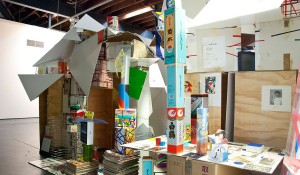
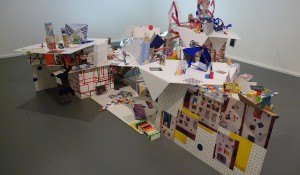
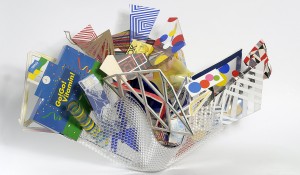
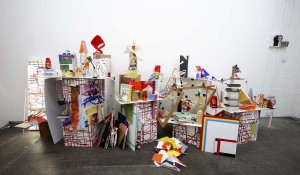
Masato Takasaka’s plundering of his earlier works to form new ones signals his strong commitment to an investigative art practice, rather than one that is product-oriented. Indeed, his practice can be seen as the one, ongoing work, resourced from the large collection of objects and materials housed in his studio. Takasaka regularly exhibits selections from the collection as installation works. After an exhibition, he returns the parts to the studio, many of the same elements appearing in successive exhibitions. Each time, different issues govern the selection and organisation of elements, although in general terms Takasaka’s work explores three linked ideas: the self-formation of artistic identity, the use of display to elicit conceptual engagement and physical experience, and the relationship between vanguard and everyday mass culture.

In the studio, the arrangement of things looks somewhat random, the sheer extent of stuff seeming to leave Takasaka little room to work while the things themselves appear quite prosaic. In the gallery, however, all is transformed, relating the artist’s work to the creation of value. Takasaka’s approach to installation draws on varied repertoires of display, including museum displays, commercial exhibition and retail design, and vanguard art. The present exhibition shares much with Kurt Schwitters’s

Merzbau. Like Schwitters, Takasaka has a compulsion to collect the remnants of material culture. The organization of objects and materials in his studio and their appearance in exhibitions suggest a more provisional and transportable version of the Merzbau. Like Schwitters, Takasaka’s gathering of elements for his work reflects his daily life, his act of exhibiting them constituting a performative autoethnography.

Takasaka has called this major iteration of his work in four rooms at Gertrude Contemporary Almost Everything All At Once, Twice, Three Times (In Four Parts…). The title plainly explains the exhibition’s relationship to the collection of materials in his studio, which has its own name, the ‘Everything Always Already-Made Wannabe Studio Masatotectures Museum of Found Refractions (1994-2012)’. The conceptual styling of Takasaka’s studio as a museum is more than an ironic reference to art world processes of collecting and display. Giving a small room of cast-off things such a grand title shows his interest in the nature of emergence. An influence here is the representation of life as a process of becoming by the French philosophers Deleuze and Guattari, counter to Western philosophy’s historical fixation with being.1 For Deleuze and Guattari, ‘becoming’ emphasizes interaction, interdependence and synergy—prime qualities of Takasaka’s work—resisting the ‘processes of stratification, over-coding and control’ through which capitalism produces the social order.2

1

G. Deleuze and F. Guattari (2002), A Thousand Plateaus, London: Continuum.

2

G. Chesters and I. Welsh (2005), ‘Complexity and Social Movement(s): Process and Emergence in Planetary Action Systems’, Theory Culture Society 22(5): 188.

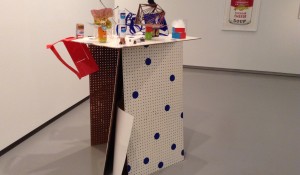
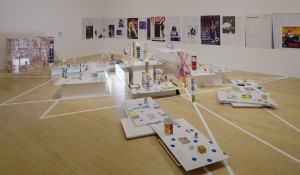
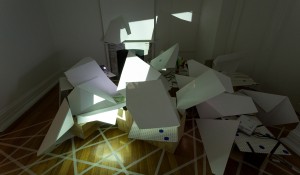
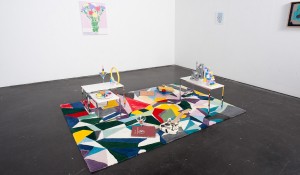
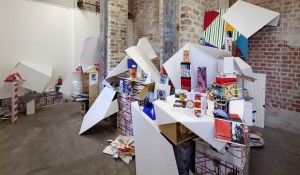
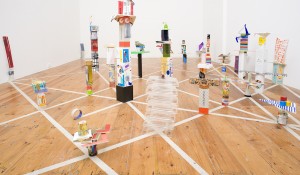
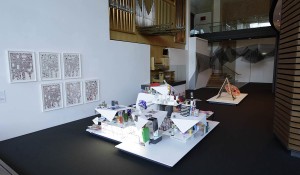
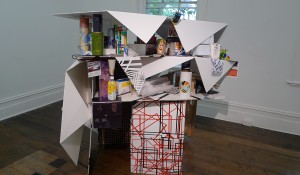
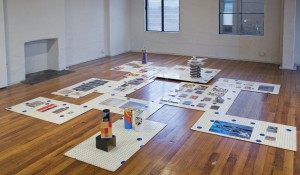
A presentation from the studio/museum can be chaotic or controlled. Takasaka trained as an architect, but found the field’s investment in function and reason too limiting. Writers since Walter Benjamin have noted the tendency of architecture to operate as a sequence of stage sets, detached from the materiality of construction. There are clear references to ‘the architectural’ in this exhibition. In one room, a field of vertical structures made of stacked packages and drink containers could be a contemporary edge-city in miniature, highlighting the issues of scale and sequestration in urban forms. In other rooms, large, jagged stacks of objects and materials dominate the space, stressing the tactical and tectonic qualities of the built form. One installation spills through a hole in the wall into the adjacent room.

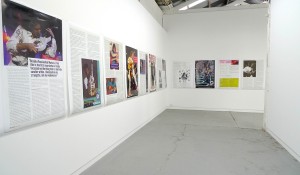
The precariousness of most structures and the way their arrangement forces you up against the gallery wall stresses that the experience of art is always embodied and involves a range of affective and sensory dimensions, not just the visual. The presence of foam-core mock-ups of the gallery space at 200 Gertrude Street, which Takasaka used in planning this exhibition, and a stack of large boxes used to store and transport the materials to the gallery, reveals the processes Takasaka uses in realising his work. For example, he underscores the repetition at the centre of a set of images of guitar heroes by lining up both large and small versions of the works and the original magazine pages on which they were based around top of the gallery wall. The use of previous works, exhibition catalogues and invitations, and magazine articles about Takasaka’s work as both the form and content of his installations documents his career as an artist, although such acts of self-representation build on the sense that any representation is never wholly true to the original referent, but rather constitutes a divergence from it.

Takasaka’s interest in a low-fidelity type of art that is forever repeating itself, but never finished indicates that for him, the new is a product of limitation and reiteration. His practice is well attuned to the investigation of today’s unpredictable world, which thrives on flux and complexity. Takasaka’s use of prosaic materials and iteration at both the macro and micro levels and in the moment and over time links the meaning and value of cultural forms to their cycle through the different levels of the social system. A practice that is one continuous project, unfolding across a sequence of times and locations, places high expectations on the viewer, but Takasaka’s aim is to provide a challenging space for the exchange of ideas, for communication and provocation, establishing a transactional relationship between artist and viewer.

Carolyn Barnes

Dr Carolyn Barnes is a Senior Research Fellow in the Faculty of Design at Swinburne University of Technology. She is an assistant editor of the International Journal of Design and a member of the editorial board of The Journal of Visual Arts Practice. Craftsman House published her monograph on the Hong Kong-Australian artist John Young in 2005

Dear _____,

You are invited to:

sushichampagnepaintingsculpture

7:00 pm, December 2, 13/117 Hardware Street, Melbourne, 3000

“What you see in this exhibition could be described as a fictional
collection, for one night only, crammed into a city apartment Herb and
Dorothy style… A survey show, a cross-section of the here and now.”

curated by Madeline Kidd

http://madelinekidd.wordpress.com/2011/12/03/sushichampagnepaintingsculpture-2/

drawing folio 2 (PDF)

 DRAWING FOLIO 2 – Ruler, Pencil, Time

John Aslanidis
Stephen Bram
Renee Cosgrave
Lesley Dumbrell
Leslie Eastman
Craig Easton
Anna Finlayson
Marco Fusinato
Briony Galligan
Nathan Gray
Melinda Harper
Ry Haskings
Brad Haylock
Matt Hinkley
Robert Jacks
George Johnson
Dylan Martorell
Anne-Marie May
Elizabeth Newman
John Nixon                                                                                                                                               Rose Nolan
Charles O’Loughlan
Robert Owen
Kerrie Poliness
Nick Selenitsch
Bryan Spier
Quentin Sprague
Masato Takasaka
Elke Varga
Robert Vinnicombe
Karl Wiebke

Curated by Justin Andrews and John Nixon

3 February – 1 March, 2012

 Opening Friday 3 February 6-8pm

 Block Projects

 79 Stephenson Street Cremorne 3121 VIC Australia

 +61 3 9429 0660

www.blockprojects.com info@blockprojects.com

Tuesday via appointments only. Wednesday – Friday 11—5pm. Saturday 11—4pm Sunday 12—4pm

Ry Haskings – Muzzle Zeal
Lisa Radford, Lane Cormick and Masato Takasaka – Whatever doesn’t work
 
Opening: Saturday 15.10.11 at 4.30 – 7pm

Stockroom Gallery
98 Piper St Kyneton

http://img703.imageshack.us/img703/1778/ribharold.jpg


Post Logical Form essay Making Tunnels by Roger McDonald (PDF)

Follow

Get every new post delivered to your Inbox.